Film/Movie Production Over Time
As part of my research work on knowledge production, particularly how it relates to the intellectual property regime I’ve recently been looking at film/movie production over time. Thanks to the semi-openness of http://www.imdb.com/ we have a fairly comprehensive database of statistics available. Combining this with the excellent IMDbPY scripts and my own home-brewed code and I was able to start extracting some basic information on movie production over time.
Points to note about the dataset:
- IMDb includes information both on films scheduled to be released, in production etc. This explains why there are data points for years in the future. These values should probably be ignored.
- It is not clear exactly how comprehensive the IMDb dataset is — and more importantly how its comprehensiveness varies over time. One might be concerned that some periods (especially early ones) are under-represented in the database in which case the figures shown will be somewhat biased.
Production as Number of Titles
Movie production as measured by titles has shown marked rises and falls over time. Specifically there is a major expansion in the 1910s followed by a sharp fall in the 1920s with continuing decline until the end of WWII (1945). Following that production steadily increased up until the 1990s when is started to grow much faster. By the mid 2000s the number of titles had broken the 10k a year barrier. We do need to be cautious here, as the number of titles may be highly misleading measure of production over time (see next section). However it is reasonable can compare across countries.
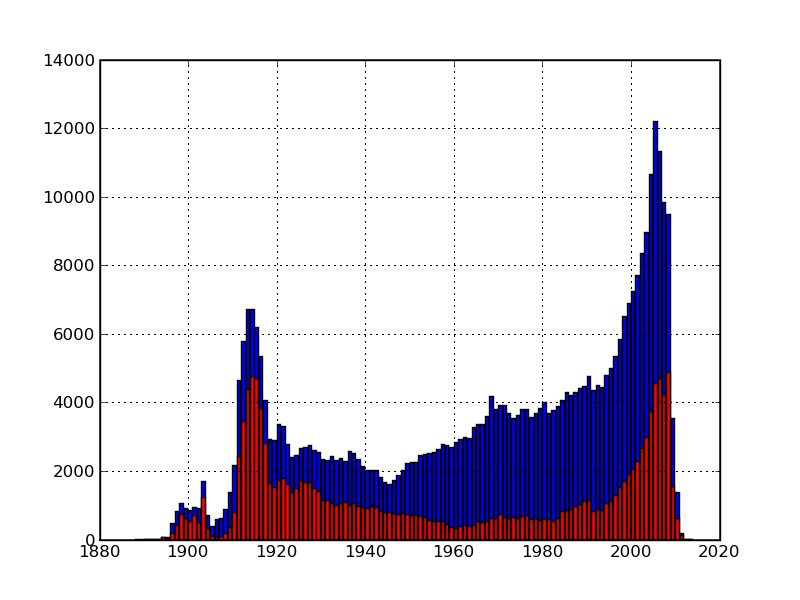
World film (blue) and US film (red) production (number of titles)
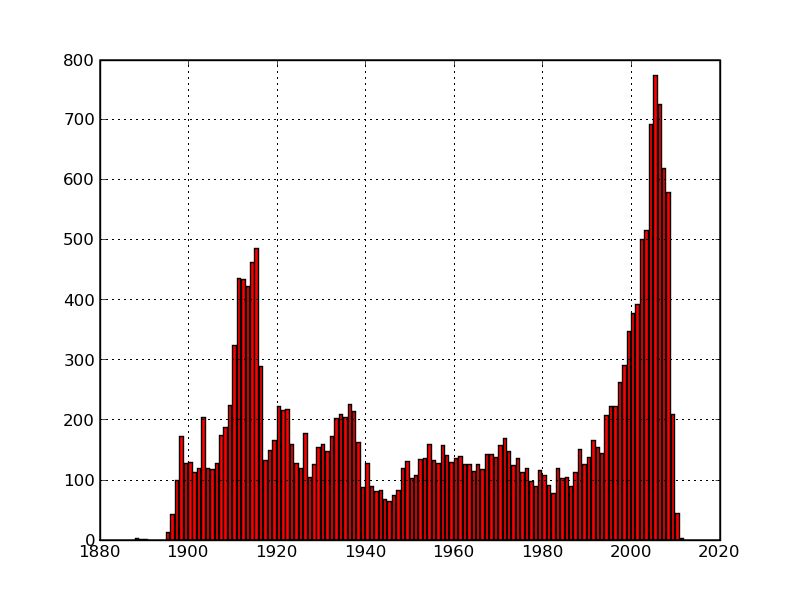
UK film production (number of titles).
While production is substantially lower than the US the overall trend is very similar.
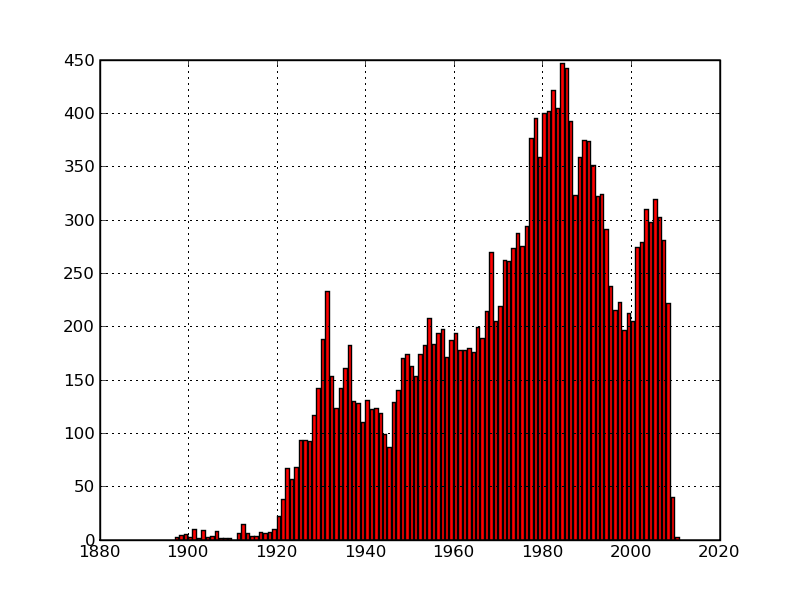
Indian film production (number of titles).
This shows a rather different trend. First production only really begins in the mid-1920s, and perhaps most interesting of all, production actually drops from the mid-1980s through to the mid 2000s. Here, however one needs to be especially concerned about IMDb’s coverage (the number of titles looks rather low particularly for recent years).
Production as Running Time
It is not clear that the number of titles is the correct measure of film production. After all a short of 5 minutes and 2.5 hour blockbuster both get counted equally. Thus, here we use total running time as a measure of production rather than the raw number of titles. As one can see this gives a rather different picture: there is a relatively smooth (and almost linear) trend upwards from 1900 to around 1990 followed by a massive explosion.
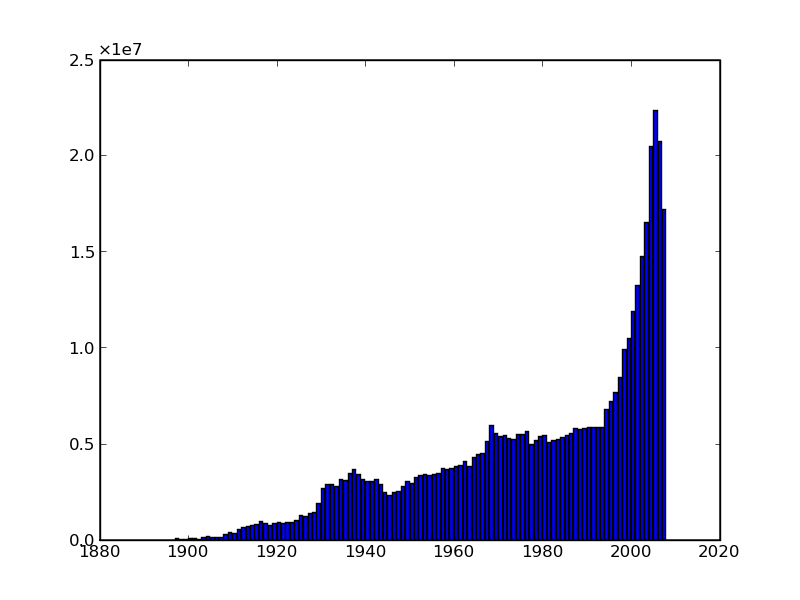
World production (running time)
2 Responses to Film/Movie Production Over Time
Leave a Reply Cancel reply
-
Categories
- *nix
- Academic
- Activity Updates
- Books
- Cinema
- Code
- Command Line
- Copyright
- Culture and Society
- Data Digging
- Economics
- EUPD
- External
- Filesharing
- Governance
- Hacks
- Happiness
- Hardware
- History
- Innovation and Intellectual Property
- Intellectual Myths
- Javascript
- Knowledge Systems
- Miscellaneous
- Musings
- Notes
- Open Bibliographic Data
- Open Data
- Open Knowledge Foundation
- Openness
- Own Work
- Papers
- People
- Photos
- Platforms
- Poetry
- Policy
- PSI
- Python
- Quote
- RDF
- Shuttleworth Fellow
- Software
- Sysadmin
- Talks
- Transaction Costs
- Work In Progress
-
Articles
- February 2012
- January 2012
- December 2011
- November 2011
- October 2011
- September 2011
- August 2011
- July 2011
- May 2011
- April 2011
- March 2011
- February 2011
- January 2011
- December 2010
- November 2010
- October 2010
- September 2010
- July 2010
- June 2010
- May 2010
- April 2010
- March 2010
- February 2010
- January 2010
- December 2009
- November 2009
- October 2009
- September 2009
- August 2009
- July 2009
- June 2009
- May 2009
- April 2009
- March 2009
- February 2009
- January 2009
- December 2008
- November 2008
- October 2008
- September 2008
- August 2008
- July 2008
- June 2008
- May 2008
- April 2008
- March 2008
- February 2008
- January 2008
- December 2007
- November 2007
- October 2007
- September 2007
- August 2007
- July 2007
- June 2007
- May 2007
- April 2007
- March 2007
- February 2007
- January 2007
- December 2006
- November 2006
- October 2006
- September 2006
- August 2006
- July 2006
- June 2006
- May 2006
- April 2006
- March 2006
- February 2006
- January 2006
- December 2005
- November 2005
- October 2005
- September 2005
- August 2005
- July 2005
- June 2005
- April 2005
- March 2005
- February 2005
- January 2005
- December 2004
- November 2004
- October 2004
- June 2004
- May 2004
- March 2004
- October 2003
-
Meta


The last graph mapping total production runtimes against production release years may reflect the impact of digital entertainment technologies, first on satellite and then on cable systems, which increased the demand for 7×24 programming into smaller and smaller market segments, around the world. It also reflects the shift to digital production technology which removed the film processing and labor-intensive post-production cycles, which shortened time-to-release, increased quality, while reducing overhead costs. Unfortunately, smaller market segments also can result in smaller returns as the diversity of digital delivery channels increases to expand to Internet and mobile entertainment platforms.
Interesting statistics!